SK materials airplus
About the Company
SK materials airplus is growing into a total air solution company through continuous business expansion, from petrochemicals to semiconductors, and a trusted company that brings happiness.
Based on the production of high-purity industrial gas through the Air Separation Unit(ASU) and the establishment of a supply chain, SK materials airplus provides stable supply solutions for various demands across industries.
Forms of Supply
Depending on the business size and conditions of each customer, we can supply off-site, on-site, and in bulk(transport by a tank lorry)
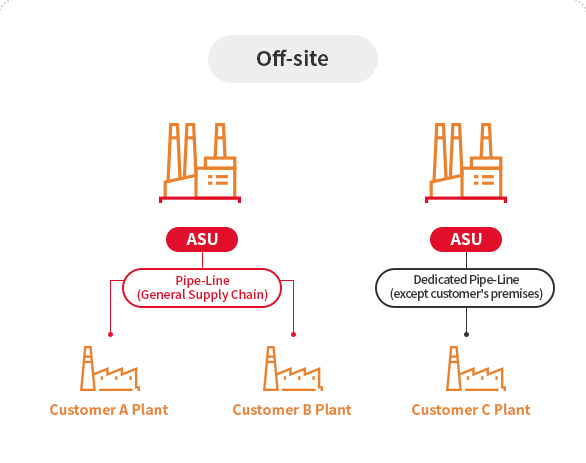
- General-purpose pipe-line construction and supply from a site near a large -scale industrial park to multiple customers
- Dedicated supply pipe-line construction and supply from a site near a specific customer
- Self-supply and operation of power
- GN2(Gaseous Nitrogen), GO2(Gaseous Oxygen), CDA(Clean Dry Air), etc.
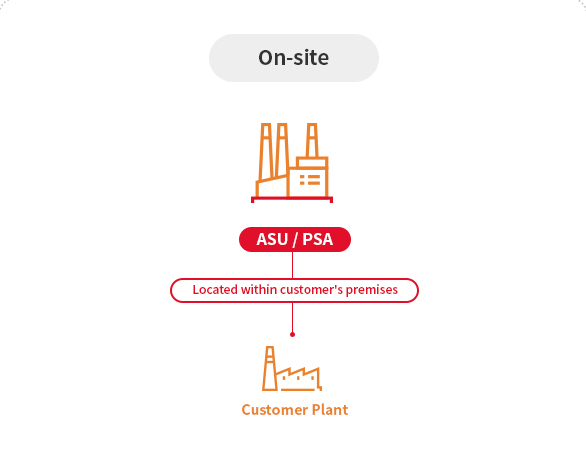
- Separate gas production through ASU, being liquefied and stored in a storage tank, and then sold as a product
- Power supply by customers
-
ASU: Cryogenic air separation method, suitable for large-scale demand (10,000Nm3/hr~)
PSA: Adsorption method, suitable for small and medium-sized customers (~10,000Nm3/hr)
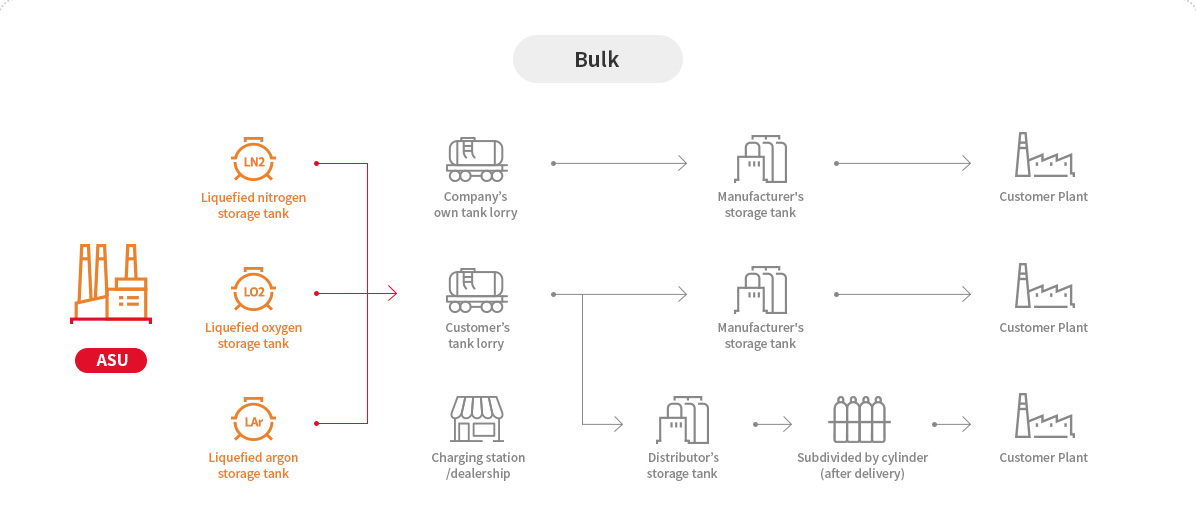
- Separate gas production through ASU, being liquefied and stored in a storage tank, and then sold as a product
- After building storage tanks and supply facilities in the customer's premises, directly transport and supply through the company's own tank lorries (to various manufacturing plants)
- Ex-factory sales through direct transport by customers (wholesale / retail distribution networks such as charging stations and dealerships)
- LN2(liquefied nitrogen), LO2(liquefied oxygen), LAr(liquefied argon), etc.
Production Process
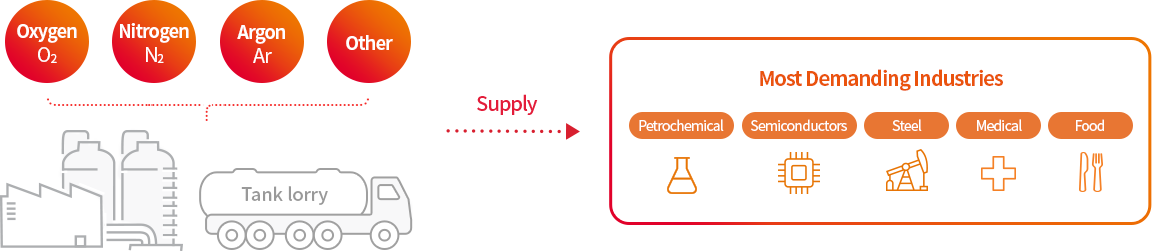
High-purity general industrial gases produced through SK materials airplus’ Air Separation Unit(ASU) is widely used for utility in the manufacturing industry.

Nitrogen
N2
Characteristics
- Occupies approximately 78% of atmospheric composition
- Separated from boiling point of -196°C
- Inert, non-flammable, colorless, tasteless, odorless
Use
- Inert atmosphere gas
- - Semiconductor, LCD, solar cell manufacturing process
- Gas for sealing, purge and cold test
- - Chemical plants, piping, tanks
- Quick freezing
- - Food, medicine

Oxygen
O2
Characteristics
- Occupies approximately 21% of the atmosphere
- Separated from boiling point of -183°C
- Inert, strong combustibility
Use
- Melting furnace, metalworking
- - Iron making, steel making, metal refining, welding, cutting
- Oxidation
- - Semiconductor materials, petrochemicals, wastewater treatment
- Other
- - Food, fermentation, and medical devices for breathing

Argon
Ar
Characteristics
- Occupies approximately 0.9% occupied of the atmosphere
- Separated from boiling point of -186°C
- Non-flammable and inert(even at high temperature and pressure)
Use
- Atmosphere gas in high temperature environment
- - Semiconductor integrated circuit manufacturing
- - Plasma chamber, plasma cutting
- - Refining of special steels
- - Carbon fiber, powder metal manufacturing

CDA
Characteristics
- Clean Dry Air
- It removes pollutants such as dust, oil, and moisture in compressed air within the required reference values suitable for the purpose, nature, and function of the system or equipment and provide them in an optimal condition
Use
- It is most often used in semiconductor production equipment together with N2, and is used for automatic operation of auto air valves, transmission devices, and other pneumatic devices in production equipment.

CO2
Characteristics
- Inert, non-flammable, colorless, odorless, water-soluble
- Recovered from organic combustion gas or produced as a by-product of alcoholic fermentation
Use
- Semiconductor wafer and facility cleaning
- - Supercritical fluid cleaning method
- Steelmaking, welding
- For cold transportation of food and beverage

H2
Characteristics
- Colorless, odorless, flammable
- High reducing properties at high temperatures
- -253°C boiling point
- Stored and supplied as gas in a high-pressure tube
Use
- Semiconductor wafer and chip manufacturing process
- Glassware and fiber optic processing
- Chemical industry / metal heat treatment reducing agent
- Rocket fuel / alternative vehicle energy
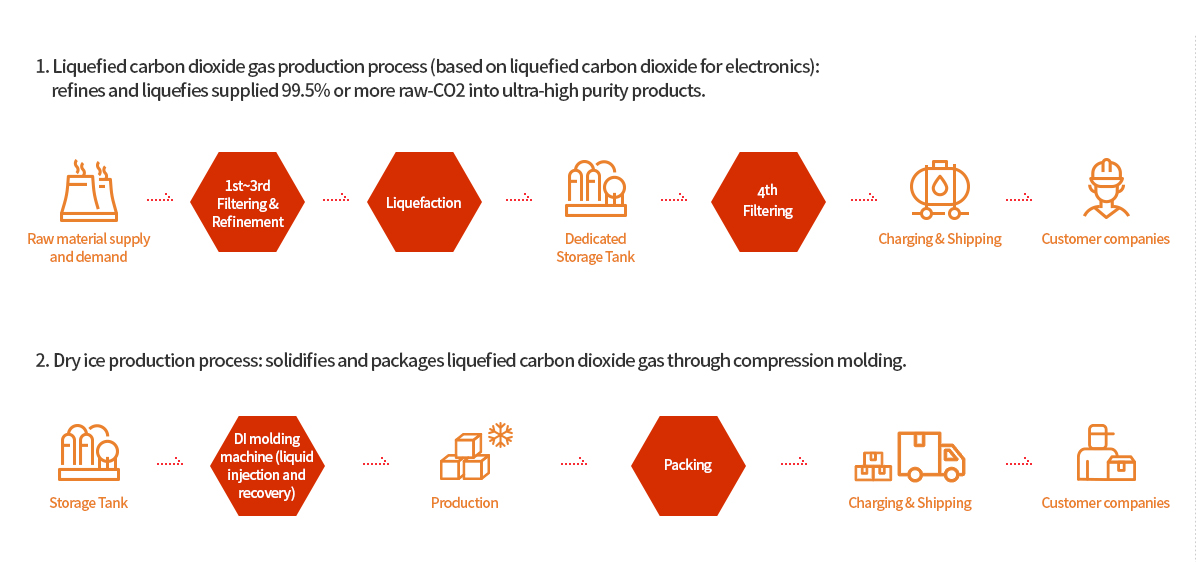
Liquefied carbon dioxide gas
Product Features
Carbone Dioxide(CO2) is a compound of carbon and oxygen, a colorless, odorless, non-flammable gas at room temperature and atmospheric pressure.
Product Application
-
For electronics
It is used to increase the precision of the photoprocess in the semiconductor manufacturing process, or as a supercritical fluid for cleaning residues.
-
For drinks
For the refreshing sensation of drinks, it is used as an additive to carbonated drinks, beer, rice wine, etc.
-
For agriculture
It is used to promote the photosynthetic activity of plants, thereby increasing yield and sugar content.
-
For medicine
It is used to increase the precision of the photoprocess in the semiconductor manufacturing process, or as a supercritical fluid for cleaning residues.
-
For industry
It is used for welding in shipbuilding, automotive industry, etc.
Dry Ice
Product Features
It is a product that solidifies liquefied carbon dioxide gas, which is excellent for rapid freezing and cooling, by sublimating into gas at an ultra-low temperature of -78.9 ℃ and taking away the surrounding heat, and is used as an eco-friendly product compared to cold insulation agents that use SAP(super absorbent resin), a type of microplastic.
Product Application
-
Food delivery
It is used to keep frozen food cool for fresh and safe delivery.
-
Medical area
It is used for the preservation and transportation of blood, vaccines, etc.
-
Industrial area
It is used for trimming operations such as processing and cutting rubber products, or for cold treatment of metals.
-
Other areas
It is used for special effects of various events, stages, etc., and for low-temperature experiments.